
Track household grocery spending by recording the total for each completed shop and reviewing those records over a consistent period. A receipt or a manually entered amount is enough to start. OurPantry brings recorded shop totals into spending history and lets you add a monthly budget. Both totals and budgets are optional, so you can use the shared grocery list on its own.
Choose a simple record you can keep using
Start with the total shown on a completed shop’s receipt. You do not need to record the price of every product to see how much your recorded grocery trips add up to. Decide which shopping trips you want the household record to include, and try to apply that choice consistently. A record of large weekly shops alone will tell a different story from one that includes smaller top-ups.
In OurPantry, you can enter the shop total yourself or photograph a receipt for text detection. Review a detected total against the receipt before relying on it. Long receipts, unclear photos, and unfamiliar layouts can make a detected amount inaccurate. Manual entry is a useful alternative when reading the total yourself is quicker.
If a record is missing, treat it as missing information. A blank total does not establish that a shopping trip cost nothing. Spending history reflects the amounts your household records, so a month with several unrecorded shops will not represent the household’s complete grocery spending.
Keep a budget alongside the recorded shops
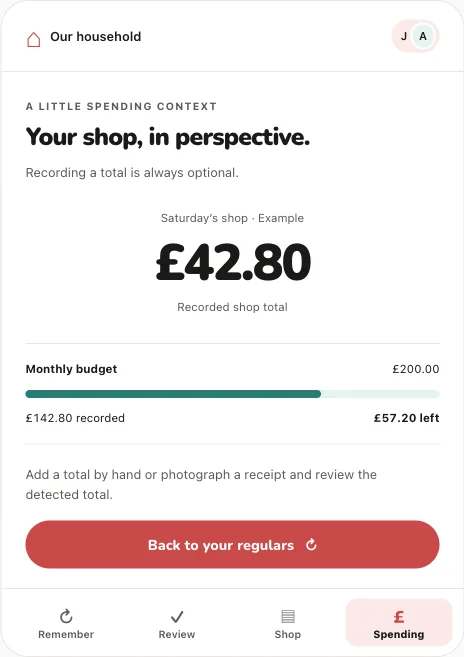
An optional monthly budget gives your recorded spending a point of comparison. Choose an amount that makes sense for the period you want to review, then look at how the recorded shops relate to it. OurPantry supports a household budget, but setting one is a personal choice and is not required to prepare or complete a grocery shop.
Be careful when comparing periods with different information in them. One month may contain several large stock-up trips, while another includes a week away. A total can tell you what was recorded; it does not explain every reason behind the amount. Talk about the specific trips if you are trying to understand a difference.
Avoid treating a budget comparison as a prediction. A remaining amount describes the relationship between a chosen budget and recorded spending at that point. It cannot guarantee what the next shop will cost, tell you which retailer is cheapest, or promise that using the app will save a particular amount of money.
Put it into practice
Let OurPantry help with your next grocery shop.
See the app in action →For UK households of two. Email us to register your interest in testing.
Make recording a shared, optional habit
Agree who records a shop total so the task does not automatically fall to the person who already plans the groceries. The person holding the receipt may be the easiest choice. If another member adds it later, check that the total is attached to the intended shopping session and that it reflects the completed trip.
Receipt information is shared household information. OurPantry stores receipt images privately for the household and sends them for text detection so the shop total can be read. Both members should be comfortable with what they choose to record. The privacy policy explains the service providers and account-deletion behaviour in more detail.
Use the spending view when it answers a practical question, such as how much you recorded for grocery trips this month. You do not need to inspect it after every item is added to the list. If recording a total is inconvenient during a particular shop, you can skip it and carry on using the planning and shopping features. A useful spending habit should give the household context without making the list harder to use or turning an ordinary grocery trip into a bookkeeping exercise.
Common questions
Can I enter a total without uploading a receipt?
Yes. You can record a shop total manually. Receipt capture is an optional way to detect the total, which you should review before relying on it.
Does spending history include shops with no recorded total?
A shop without a recorded total cannot contribute a known amount to spending. Use the history as a view of recorded spending and remember any missing totals when comparing it with a budget.
Explore how OurPantry works or find more help in our support answers.